


By Rachel Cline · October 1, 2026


Episode 43 · Radiantly Rooted with Rachel
If the constant hum of midlife anxiety has started to feel like your new normal, this 15-minute practice of EFT tapping for anxiety might help. Tap along with me through three gentle rounds and a few slow breaths at the end.
Today I wanna do something a little bit different, and we are actually gonna do a practice together, and it is one that has been helping me a lot lately. So if we haven’t met yet, my name is Rachel Cline, and I have been doing this inner work for probably 30 years now and guiding other women down this path for the past 11 years.

In this episode
- Why I’m Sharing This Practice
- What Is EFT Tapping?
- The Tapping Points
- Round 1: Naming What You Feel
- Round 2: Honoring Why It’s Here
- Round 3: Coming Home to Your Body
- Mindfulness and Breathing
- Closing and Resources
Why I’m Sharing This Practice


Now, I was introduced to EFT, emotional freedom technique tapping, a long time ago, and it’s always been one of those tools that I kinda keep in my back pocket. Lately though, I have found myself reaching for it a lot more because my anxiety has been higher than normal. Some mornings I wake up and it’s already there, humming along before my feet even hit the floor. And I have noticed that the same conversation has come up over and over again with clients, with the women I talk to.
“Some mornings I wake up and it’s already there, humming along before my feet even hit the floor.
They tell me that low hum of anxiety has started to feel like their new normal. The things that used to help aren’t working anymore. Their self-care stack is just not doing it. And as we get into our 40s and our 50s, nothing seems to touch it. Some of them have told me that the anxiety is what is actually keeping them from building the habits that they know would help.
And others have said that their stress and anxiety is going to affect their health. So if any of that sounds familiar, this episode is for you. We’re actually gonna practice EFT tapping for managing anxiety in midlife. Now, if you are listening in the car right now, I invite you to please just listen along for today and then come back to tap with me when you are parked or at home.
And I did make a printable version of this whole tapping practice, so you don’t have to try to remember any of it. And you can grab it at the link in the show notes, and I’ll remind you again at the end.
What Is EFT Tapping?
So before we dive in, what is tapping? EFT, it stands for emotional freedom techniques. Most people just call it tapping because that’s literally what you do.
I’ll show you here shortly. You tap lightly with your fingertips on a few acupressure points along the body’s meridians while you say out loud what you’re feeling, what you’re processing. Researchers think that tapping on these points sends a calming signal to the amygdala. Now, that is the part of your brain that sets off your fight or flight response, your stress response.
And so over time, with practice, that may help your brain and your body learn a new response to stress. And what I love about tapping is that it really brings your body into it. So many of us try to think our way out of anxiety, right? To logic our way out of it or overthink our way out of it. And when your nervous system’s on high alert, thinking alone usually doesn’t get you very far.
“So many of us try to think our way out of anxiety, right?
It ends up spiraling you even deeper into that rumination. And so tapping gives your body something to do while you name what’s going on. And so the first step is getting really honest about how you are feeling. You’re not trying to talk yourself out of it. You’re telling the truth, and you are giving your body permission, letting it know it’s safe to settle down just a little bit.
How This Practice Works
And so here’s how this is gonna work today. I’m gonna say a phrase, and if it resonates with you, you’ll repeat it after me, out loud if you can, or in a whisper or in your mind if you’re somewhere where you can’t. If you need to change the phrase or the words to make it match what you’re going through, that’s fine.
You can do that. This is just one example. There are many ways to do this, and there’s no way to do it wrong. If you miss a point, if you mix up the order, it’s totally fine, so no worries about that. And so I’m gonna show you each one here on video. If you’re listening, I’m gonna do my best to talk you through it.
“There are many ways to do this, and there’s no way to do it wrong.
I’m gonna walk you slowly through each point the first time, and then we’ll actually put it into practice.
The Tapping Points

Save this on Pinterest
The Karate Chop Point
So we start on what they call the karate chop point, and that is the fleshy outer edge of your hand, the part that you would actually use for a karate chop. And so you can make just a soft fist with that hand if you want to, and you’re going to tap on that outer edge of your hand between your pinky and your wrist, and you’re just gonna tap on that with all four fingertips of your other hand.
So not the thumb, but the four fingers. And you just tap on the outer edge of your hand. And we’ll move through the rest of the eight points. And so we tap about seven times at each one, roughly.
The Face Points
So next is the eyebrow point, and that is right where your eyebrow starts, right where it meets the bridge of your nose. And you’re gonna tap with your index finger and your second finger, and it’s very, very gentle. You can do this with just your right hand, you can do this with just your left hand, or you can do it with both hands at the same time. And it’s just a gentle, gentle tapping right where your eyebrow ends, right where it meets the bridge of your nose.
The next spot is the side of your eye, and it’s not all the way out to the temple. It’s right there at that bone, right at the outer corner of your eye. And you just wanna gently, gently tap on that. And then you move right underneath the eye, and that’s with two fingers again, very, very gently on top of your cheekbone.
And then after that, with one hand, two fingers, your first finger and your second finger, right underneath the nose, and it’s that little space right above your upper lip and below your nose.
The next spot is the chin, and it’s that little crease right between your lower lip and your chin.
Collarbone, Under the Arm, and Top of the Head
And then we move down to the collarbones, and you can use both hands if you want to, all 10 fingers. And you’re just gently tapping all 10 fingers on your body right below where your collarbones meet and maybe about an inch out to either side.
From here, we move under the arm. It doesn’t matter which arm, but it’s on your side right under the arm about a hand’s width beneath your armpit. And you’re just tapping there.
And then the final spot is the top of your head. So that is just a quick overview of the tapping spots. And so I’ll invite you to do this when you are in a space where you can give yourself the time to relax, to experience it, to see what comes up for you.
Check In Before You Begin
And so before we start, let’s just take a breath together. Take a long, slow, deep breath in, and gently let it go. And I’ll invite you to let your feet rest on the floor if you can. And just notice where you feel the anxiety in your body right now. Maybe it’s a tightness in your chest. Maybe it’s a knot in your stomach. Maybe your jaw is so clenched it’s sore.
Maybe your mind feels like it’s heavy because it’s going so fast in a million different directions. It’s tired of carrying all that mental clutter. So notice where the anxiety is in your body right now.
And then rate it on a scale of zero to 10. How strong does it feel? And just notice the number. There’s no judgment here, just for awareness. How strong does it feel? So zero would be you’re not noticing any sensation right now at all. 10 is the worst it could possibly be.
“There’s no judgment here, just for awareness.
Round 1: Naming What You Feel
The Setup Statements
And so we’re gonna do three rounds of tapping. And so again, you’re welcome to change these words as we move through them. And we’re gonna start tapping on that karate chop point. So I’m taking the four fingers of my right hand, and I am gently tapping on the outside edge, the pinky-side edge of my left hand, right between the wrist and the bottom of the pinky finger.
And it’s just a gentle tapping. And you can repeat after me, changing any words as needed. Even though I woke up with this anxiety already humming in my body, I’m going to be kind to myself about it.
Even though this tightness in my body has started to feel normal, I’m willing to pay attention to it. And we’re still tapping on that karate chop point. Even though I’m the one everyone leans on and I can’t seem to settle myself, I accept how I feel right now.
Tapping Through the Points
Now let’s move through the points. I’m gonna start with the eyebrow, and I’m just gonna do one hand. You can do both if you want to. Tapping right inside the eyebrow, right where it meets the bridge of your nose. The anxiety humming in my body.
Moving to the side of the eye, the outside edge of the eye, right on the bone. It was here before I even got out of bed. Underneath the eye. I can feel it wherever it’s sitting in my body. Under the nose, two fingers. My thoughts are running in 10 directions. The chin. And part of me just wants to get away from this feeling. Collarbone with all 10 fingers. It’s been here so long it feels like my new normal. I’m tired of carrying it.
Under the arm, and on top of the head. I’m letting myself feel it just for right now. Then relax. Release your hands. Take a deep breath in. Let it out slowly. Check in with that number again, zero to 10. Has anything shifted, even a little? There’s no right or wrong, just noticing.
Round 2: Honoring Why It’s Here
The Setup Statements
And so round one was all about naming what you feel. In round two, we are honoring why it’s here. So we’re gonna come back to that karate chop point. So I’ve got the four fingers of my right hand tapping gently on the outside edge of my left hand. You can repeat after me.
Even though the things that used to help me aren’t working anymore, I’m giving myself some grace. Even though I know how to help other people with this and I can’t seem to fix it for myself, I accept that I am human. We’re still on that karate chop point. Even though this anxiety keeps getting in the way of the habits I know would help me, I’m open to starting small.
Tapping Through the Points
We’re gonna move to the inside of the eyebrow. One hand or both with two fingers. Maybe I know why I’m anxious, and maybe I don’t. Side of the eye, right on the bone. Maybe it’s one big thing or 100 little ones. Under the eye. My body has been on high alert for a long time. Under the nose. It’s been working so hard to protect me.
The chin with two fingers. I keep trying to fix it, and it keeps coming back. Collarbone, all 10 fingers right under the collarbone. Even my body is telling me something needs to change. Underneath one arm, tapping. What if I stop fighting this feeling for a minute? Top of the head gently. I’m safe right here in this moment.
You can release your hand. Take a deep breath in. Gently let it go. And then check in with your number. 0 to 10, where do you feel that anxiety in your body, and how strong is it? Has it shifted at all?
Round 3: Coming Home to Your Body
And so this final round we’re doing today is all about coming back home to your body. And so we’re gonna start by coming back to the karate chop point, so tapping on the bottom of one hand with the four fingers of the other hand. You can repeat after me.
Even though some of this anxiety may still be here, I’m choosing to come home to my body. Even though I don’t have all the answers, I can find my footing right here. Still chopping on the karate chop point. Even though I’m still figuring out who I’m becoming, I’m learning to trust myself.
Move to the inside of the eyebrow. One hand or both hands, two fingers. I’m feeling my feet on the floor. Side of the eye, and breathing all the way down into my belly. Under the eye, letting my exhale get a little longer. Under the nose. I don’t have to think 10 steps ahead. Chin. I don’t have to solve all of this today. Collarbone. Both hands, 10 fingers. My shoulders can drop, and my jaw can soften. Under the arm. I’m finding my footing one small step at a time. Top of the head, I’m coming home to myself.
And then let your hands rest.
Mindfulness and Breathing
And before we finish, I’m gonna bring in one more piece because this is where the magic really happens for me. Mindfulness is a big part of how I work with women. And when you pair it with tapping, you start to break the pattern. So instead of the anxiety running the show all day, you catch it, you notice it, and you give your body a chance to feel safe again.
So let’s take a moment to do that together. You might rest one hand on your heart and one hand on your belly. Press your feet into the floor. And breathe in for a count of four, and out for six. Breathing in for four, breathing out for six. And one more time, breathe in for four, breathe out for six.
You can release your hands if you want to. And just one more time, check in with that number. What is it now? Has it shifted at all? Whatever it is, just notice what’s different, even if it’s small. Every little bit counts, and it gets easier the more you practice. The more often you tap, the faster your body remembers how to settle.
“The more often you tap, the faster your body remembers how to settle.
And I like to do that first round when I get out of bed in the morning before I reach for my phone. We always reach for our phone. It’s so easy to do, right?
A Gentle Note About Your Health
Now, I also wanna say this, tapping is a wonderful support, and it does not replace medical or mental healthcare. So if your anxiety is new or if it’s getting worse, if it’s affecting your sleep or your health, please talk with your doctor.
Hormone changes in perimenopause and menopause can play a big part in midlife anxiety, and that deserves a real conversation with your provider. So be mindful to take charge of your own health sovereignty. And if tapping stirs up something that feels bigger than you wanna handle on your own, then please reach out to a mental health professional or a trained EFT practitioner.
Closing and Resources
And so remember, I made a printable version of everything we did today with all three rounds, every tapping point, and the breathing practice at the end so you can keep it on your nightstand if you want to. You can save it to your phone for those mornings when that hum shows up before you get out of bed.
And again, I’ll place that link down in the show notes below. And if you are in the middle of a big transition yourself and you’re ready to find your footing again, that’s exactly what I do.
I help women in midlife move through identity shifts with intention so that they can reclaim their voice, reconnect with what matters, and step fully into the woman that they are becoming. I’ll place that link in the show notes as well.
I am walking this journey with you. If this was helpful to you, feel free to forward it to somebody that would benefit from this practice. And while you’re here, be sure to subscribe so you don’t miss an episode.
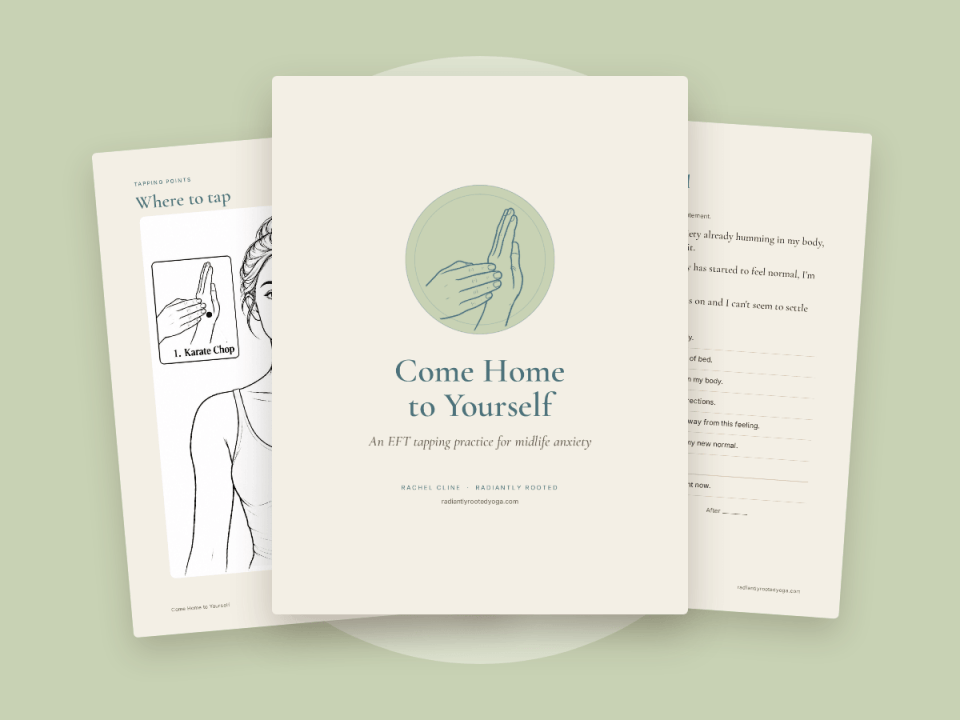
Get the free printable tapping guide
All three rounds written out, a map of every tapping point, the closing breath practice, and a log to track how things shift over time. Keep it on your nightstand for the mornings the hum shows up before you do.
In the middle of a big transition and ready to find your footing again? Learn about working with me.
Frequently Asked Questions
What is EFT tapping?
EFT stands for Emotional Freedom Techniques. You tap lightly with your fingertips on a series of acupressure points on your hand, face, and upper body while you say out loud what you’re feeling. Researchers think it sends a calming signal to the amygdala, the part of the brain behind the fight or flight response.
How long does EFT tapping for anxiety take?
This guided practice takes about 15 minutes, and a single round takes only two or three. Rate your anxiety from 0 to 10 before you start and again after each round so you can notice what shifts. Some days one round is plenty, and some days you’ll want to repeat it.
Can tapping help with midlife anxiety?
Tapping can be a helpful support when anxiety starts to feel like your new normal, because it brings your body into the process instead of trying to think your way out. It doesn’t replace medical or mental health care. Hormone changes in perimenopause and menopause can play a big part in midlife anxiety, so if yours is new or getting worse, talk with your doctor.
What if I feel silly or don’t feel anything?
That’s completely normal, especially the first few times. There’s no way to do it wrong, and you can change the words until they feel true for you. Even a small shift in your number counts, and it gets easier the more you practice.
How do I keep tapping on my own?
Many people like to tap first thing in the morning, before reaching for their phone. The free printable tapping guide has every round written out, a map of the tapping points, and a log to track your progress, so you can come back to it any time.
One breath, one moment at a time, we return to ourselves.

